Glitch Feminism by Legacy Russell
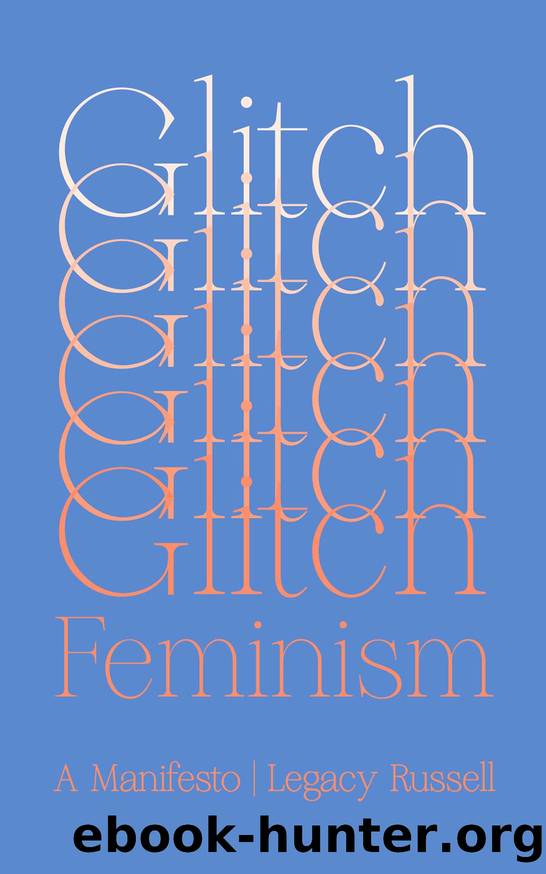
Author:Legacy Russell
Language: eng
Format: epub
Publisher: Verso Books
07 â GLITCH IS ANTI-BODY
In the body, where everything has a price,
I was a beggar.
âOcean Vuong, âThresholdâ
Glitch is anti-body, resisting the body as a coercive social and cultural architecture. We use body to give form to something that has no form, that is abstract, cosmic. Philosopher Jean Luc-Nancy puts it perfectly: âDoes anyone else in the world know anything like âthe bodyâ? Itâs our old cultureâs latest, most worked over, sifted, refined, dismantled, and reconstructed product.â1 A lot of work is put into trying to give the body form.
Artist and filmmaker Lynn Hershman Leesonâs notion of the âanti-body,â as introduced in her 1994 essay âRomancing the Anti-body: Lust and Longing in (Cyber)space,â lays useful groundwork for thinking of glitch as a mode of resistance against the social, cultural framework of the body.2 âLike computer viruses,â Leeson writes, anti-bodies âescape extinction through their ability to morph and survive, exist in perpetual motion, navigating parallel conditions of time and memory.â3
The glitch thus advances Leesonâs âanti-bodyâ as a tactical strategy. This strategy becomes operable in the face of the failure of the systematized networks and the frameworks within which we build our lives. Glitches gesture toward the artifice of social and cultural systems, revealing the fissures in a reality we assume to be seamless. They reveal the fallibility of bodies as cultural and social signifiers, their failure to operate only as hegemonic normative formulations of capital weaponized by the state. The binary body confuses and disorients, pitting our interests against one another across modalities of otherness. State power in this way positions us all as foot soldiers at the frontlines of a most dangerous tribal war. We can do better.
The current conditions of the world, however flawed, ought not to preclude glitched bodies from the right to use imagination as a core component of mobilizing and strategizing with care toward a more sustainable futurity. Leeson observes, âthe corporeal body [as we have known it] is becoming obsolete. It is living through a history of erasure, but this time, through enhancements.â4 Glitched bodies rework, glitch, and encrypt traces of ourselves, those new forms of personal digital data left behind. As the understanding of what makes up a âpossibleâ body changes under this pressure, the information associated with our physical forms, now abstracted, changes, too.
We can see example of anti-body in the fictional character and âit girlâ Miquela Sousa, known via her Instagram personality Lil Miquela. Lil Miquela was launched as a profile in 2016; however, it was not until 2018 that Lil Miquela claimed the identity of a sentient robot. Created by an LA-based company called Brud with the aspiration of becoming a prototype of âthe worldâs most advanced AI,â Lil Miquela is described by the Brud Team as âa champion of so many vital causes, namely Black Lives Matter and the absolutely essential fight for LGBTQIA+ rights in this country. She is the future.â Yet, Lil Miquela has no body.
We wonder: What purpose can a body that has no body serve? In the
Download
This site does not store any files on its server. We only index and link to content provided by other sites. Please contact the content providers to delete copyright contents if any and email us, we'll remove relevant links or contents immediately.
| Anthropology | Archaeology |
| Philosophy | Politics & Government |
| Social Sciences | Sociology |
| Women's Studies |
The remains of the day by Kazuo Ishiguro(9081)
Tools of Titans by Timothy Ferriss(8490)
Giovanni's Room by James Baldwin(7432)
The Black Swan by Nassim Nicholas Taleb(7193)
Inner Engineering: A Yogi's Guide to Joy by Sadhguru(6835)
The Way of Zen by Alan W. Watts(6669)
The Power of Now: A Guide to Spiritual Enlightenment by Eckhart Tolle(5854)
Asking the Right Questions: A Guide to Critical Thinking by M. Neil Browne & Stuart M. Keeley(5831)
The Six Wives Of Henry VIII (WOMEN IN HISTORY) by Fraser Antonia(5557)
Astrophysics for People in a Hurry by Neil DeGrasse Tyson(5224)
Housekeeping by Marilynne Robinson(4502)
Double Down (Diary of a Wimpy Kid Book 11) by Jeff Kinney(4332)
12 Rules for Life by Jordan B. Peterson(4331)
Ikigai by Héctor García & Francesc Miralles(4310)
The Ethical Slut by Janet W. Hardy(4307)
Skin in the Game by Nassim Nicholas Taleb(4305)
The Art of Happiness by The Dalai Lama(4167)
Skin in the Game: Hidden Asymmetries in Daily Life by Nassim Nicholas Taleb(4050)
Walking by Henry David Thoreau(3998)
